Innovations have always been the bedrock for growth. It is the ability to continually invent and reinvent that enables a society to keep up with changing times. This is achieved by developing solutions to novel challenges and setting new ground-breaking trends so that disrupters could stay ahead of the curve. Research showed that innovations could make significant contributions to growth and there’s even significant spillovers between countries, firms and industries, and to a lesser extent from government-funded research (Cameron, 1996). These trends don’t have to be in the area of technology. It could be in an area that’s beyond technology, for example in the domain of art and culture. Arts-based innovations are shown to be essential for the further progress in sustainable development of economy, society, democracy and ecology in a new balance (Carayannis, Bast and Campbell, 2015).

Take for example, in the early days, the Taiwanese film industry was trending and there was a lot of attention that’s focused on the Taiwanese. All those attention brought along some direct or indirect benefits. How? Every time you aired a Taiwanese movie, you would earn revenues from the film and in addition to that, also promote many Made-in-Taiwan products and Taiwanese culture. Apart from this, there could be other forms of indirect benefits too. Let’s say a group of Taiwanese businessmen went overseas to negotiate business deals and because of the popularity and wide acceptance of Taiwanese films, they could jolly-well skip the introductory phase with potential clients and be more easily accepted. Fast forward to a few years later, the Hong Kongers took the throne in the film industry. Another few years down the road, that seat was taken by the Japanese and later by the Koreans. The Korean pop stars are currently trending quite well on different social media platforms as evidenced by the statistics on Twitter and Google Trends. Here is a snapshot of the trends on Twitter on 28 Jan 2021 and this is what I got.

For your information, BlackPink is the top trending topic for Worldwide when I extracted this information and they are one of the top Korean girl bands in Korea right now. I don’t know what’s PURRR so I did a quick search and it seems to be related to BlackPink as well. That’s how trending BlackPink is. KPop is cut-throat business. They have to continually reinvent themselves in many areas such as fashion, dance moves, design of the backdrop, music styles, etc. I strongly believe their continuous innovation and hard work are paying off.
Do you think KPop somehow or rather is helping the Korean economy either directly or indirectly? If not, maybe you could go for some Chimaek (pairing of Korean fried chicken and beer) and ponder about it? What I am trying to argue here is, there are direct and indirect benefits to innovation. Innovation is important.
By creating something new, I believe that people are encouraged to look forward, train their attention towards a goal and buy into a collective future. Keep the positivity going and more people will want to be part of that future. Of course, the past is important too because I believe that having a past with strong achievements is the reason for a solid present. Importantly, it serves as a concrete foundation for a marvelous future. But the past is definitely not indicative of future performance, because innovations could be transformative and have the potential to turn/ flip things around, for the better.
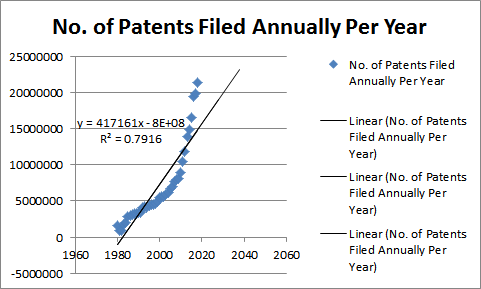
Ok, so that’s my case for innovations being the bedrock for growth. I want to understand how innovative our world is. Many experts agreed that innovation is crucial for a robust economy but the problem of measuring innovativeness has not been resolved. Even then, empirical evidence suggests that patents provide a fairly reliable measure of innovative activity (Acs, Anselin, Varga, 2002). As such, I obtained this set of statistics (number of patents filed globally per year) from the World Bank and represented it as a graph for easy visualisation. Here goes.

It was recorded that there was 21,325,538 patents filed in 2018 alone. 21 million patents. 210 lakhs patents. We have so many patents in just 2018 alone. A quick tally showed that the globe has a total of 267,394,763 patents since 1980. That’s how much data we have on innovations. Using a Linear Regression Analysis (below graph – R2 of 0.7916) to forecast 20 years into the future, it is estimated that the number of innovations will still grow but at a slower rate after 2022. Of course this modelling is based on historical data and we should also take into consideration other laws such as the Moore’s law. Earlier I already brought up that historical performance is not indicative of future performance. Haha, but now I am using historical data for scenario analysis and we are studying one that suggest the slow down in the number of patents filed per year.
What if we could once again supercharge the innovation process given that we have so much data on hand?
With machine actionable data, maybe we could apply a wide variety of artificial intelligence tools on the data set to generate insights that could be used for decision making on a strategic level in all kind of organisations. According to research by University of Cambridge, they explored an approach to develop a technology roadmap to facilitate collaboration and coordinated action within the patent analytics community. The approach would bank on several identified technologies such as artificial intelligence, neural networks, fifteen complementary technologies, like block chain, and five new technologies, such as technologies for linking databases, to be adopted in the field and are important in overcoming the innovation problems (Aristodemou, Tietze, Athanassopoulou, Minshall, 2017). There were even research on how these patent data could be harnessed to detect key biotechnology firms that are likely to successfully develop treatments and vaccinations against pandemics like COVID‐19 (Guderian, Bican, Riar, Chattopadhyay, 2020).
How about using patents to predict the future?
Why not?
There are already many tools that leverage social media in some ways to predict the future. Social media data provides a glimpse into the internet users’ everyday thoughts and feelings. Because user behavior on social media is a reflection of events in the real world, many researchers have realised they can use social media to forecast, making predictions about the future (Phillips, Dowling, Shaffer, Hodas, Volkova, 2017). In this case, I am arguing that the posts that are being shared on social media are constructed based on factors that are vastly different from those of filed patents. Patents are expensive and require significant investment of time and various resources.
By leveraging an amalgamation of AI tools, perhaps we can go beyond data analytics such as predicting companies’ technological strengths, and push the boundary further into AI-inspired forecasting of various future scenarios?
Given the current arsenal of AI tools such as ANN and DL.
Why not?
References
Cameron, G. (1996). Innovation and economic growth. University of Oxford.
Bast, G., Carayannis, E. G., & Campbell, D. F. (Eds.). (2015). Arts, research, innovation and society. Springer International Publishing.
Top 10 Countries People See as Most Innovative. (n.d.). Retrieved from https://www.usnews.com/news/best-countries/articles/2019-01-25/worlds-most-innovative-countries-by-perception
Acs, Z. J., Anselin, L., & Varga, A. (2002). Patents and innovation counts as measures of regional production of new knowledge. Research policy, 31(7), 1069-1085.
Aristodemou, L., Tietze, F., Athanassopoulou, N., & Minshall, T. (2017). Exploring the future of patent analytics: a technology roadmapping approach.
Guderian, C. C., Bican, P. M., Riar, F. J., & Chattopadhyay, S. (2020). Innovation management in crisis: patent analytics as a response to the COVID‐19 pandemic. R&D Management.
Phillips, L., Dowling, C., Shaffer, K., Hodas, N., & Volkova, S. (2017). Using social media to predict the future: a systematic literature review. arXiv preprint arXiv:1706.06134.

The only productivity tool you’ll ever need!
Don’t you wish you could IMPROVE PRODUCTIVITY and INCREASE COLLABORATION among your staff while doing away with all the hassle? After trying out so many productivity and office tools, I discovered that Google Workspace is the BEST TOOL for both remote and on-site working!

Apart from using the Google Workspace, I want to provide you with even more EXCITING VALUE for your company’s GROWTH and EXPANSION. Today, I am giving out two promotional codes that you could apply and start SAVING MORE MONEY!
| Plans | Promotional Codes |
|---|---|
| Google Workspace Business Starter Plan | EAAY74Q979XD49K |
| Google Workspace Business Standard Plan | YATVPVG39EFFFGW |
Click here to start GROWING NOW!
 Terra Link Research